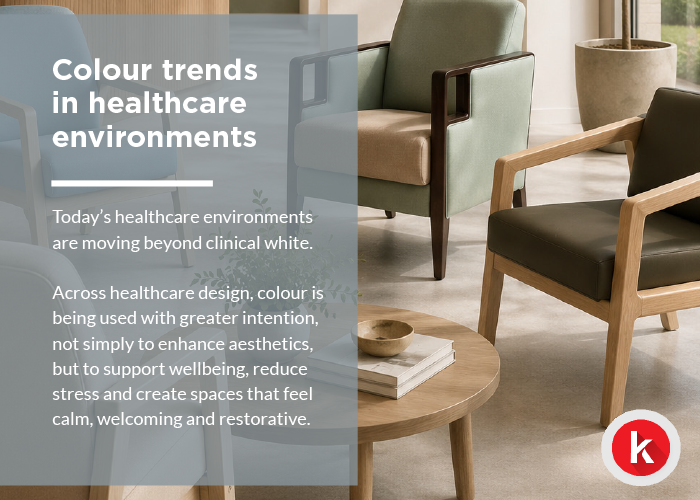

Design conversations tend to skip past the unglamorous requirements as fast as possible, treating them as the fine print you deal with after the real thinking is done. Fire retardancy. Cleanability. Ligature resistance. Load testing. These get filed under compliance, necessary, unavoidable, and, the implication goes, essentially separate from design itself. Design is the interesting part: the form, the material, the feeling of a space. Regulation is the part you satisfy quietly in the background before the real design conversation starts.
That distinction doesn’t hold up, and healthcare furniture is one of the clearest places to see why.
What a regulation actually is
A fire safety standard isn’t an obstacle placed in front of good design. It’s a record of something that went wrong badly enough that an entire industry changed its practices to make sure it didn’t happen again. Behind almost every clause in a furniture safety regulation is a specific, concrete failure, a material that performed worse than assumed, a design that behaved unexpectedly under real conditions. Treating that history as paperwork misses what it actually is: the most rigorously tested design brief most objects will ever get. Nobody has to guess whether a compliant foam will behave a certain way in a fire. That question has already been answered, expensively and definitively, by people whose job was making sure it never had to be answered again the hard way.
Cleanability works the same way, just with a slower, quieter cost. A seam in the wrong place isn’t a small manufacturing detail, it’s a place fluid and bacteria can collect, in a room where infection control isn’t an inconvenience but the entire point. Get that decision wrong and the consequence doesn’t show up as a design critique. It shows up months later, in an infection rate, traced back to a choice nobody thought was a design choice at all because it was filed under “specs” instead of “aesthetics.”

Why separating the two is the actual mistake
The temptation is to treat comfort and performance as a trade-off: soften the aesthetic and you sacrifice durability; harden the performance and you get something institutional. That’s true only if the two are solved separately, in sequence, by different people at different stages. It stops being true the moment they’re treated as one problem from the start.
An armrest’s height is simultaneously an accessibility decision, how easily someone can push themselves up unaided, and a visual one, whether the chair reads as clinical or considered. A seam’s placement is simultaneously a hygiene decision and a texture decision. These aren’t two decisions happening to occupy the same part of the chair. They’re one decision, viewed from two angles that most process treat as unrelated.
This is where the real design work actually is. Not in choosing a nicer fabric after the compliant frame has already been settled, but in the harder, less visible work of finding a single answer that satisfies the regulation and the room at the same time. That’s a genuinely difficult design problem, arguably a more interesting one than picking a color palette, and it gets almost none of the credit, because it doesn’t photograph well and nobody puts “passed the load test elegantly” in a portfolio.

Taking the requirements seriously, on purpose
None of this is an argument for making peace with compliance as a necessary evil. It’s an argument for taking it seriously as design input, treating the regulation with the same creative attention usually reserved for the parts of the brief that are more fun to talk about. The furniture that actually earns the word “considered” isn’t the furniture that looks soft despite the standards it has to meet. It’s the furniture where you can’t tell where the standard ends and the design begins, because for the people who made it, they were never two separate questions.