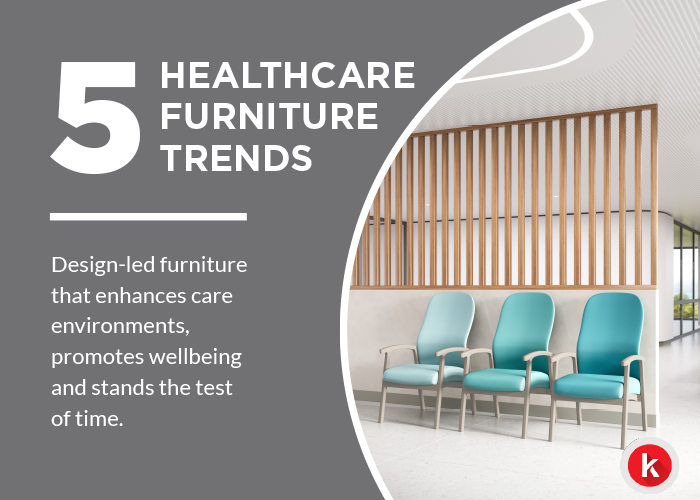
Healthcare interiors have changed.
The institutional cues once accepted as unavoidable; hard surfaces, clinical palettes, furniture chosen almost entirely for function; are giving way to spaces that feel warmer, calmer, more considered. “Hospitality-inspired” has become the shorthand for that shift.
Why the metaphor breaks down

But healthcare doesn’t need to become a hotel. A hotel lobby is designed for people who chose to be there. A waiting room is designed for people who didn’t. That difference matters more than the aesthetic similarities suggest, and it’s why importing hospitality’s look without its reasoning tends to fall flat. You end up with a lobby that photographs well and still feels hollow to the person sitting in it at 7am waiting for a biopsy result.
What healthcare can actually borrow from hospitality is narrower, and more useful: attention to experience.
What attention to experience actually means
Good hospitality design asks how someone arrives, where they wait, what they touch, how they move through a room, whether the space makes them feel expected rather than processed. Those questions matter in healthcare too, arguably more.
A waiting chair isn’t just floor space. Someone may sit in it anxious about a diagnosis. A family lounge isn’t just a furniture line item. It may be where people spend the worst hours of their year. A patient chair has to hold both things at once: comfort, and the practical weight of care.
That’s the harder design problem, and it’s the one worth solving.
Where performance and warmth collide
Healthcare furniture can’t give up durability, hygiene, accessibility, cleanability, or operational performance to get a softer look, a chair that can’t be properly cleaned between patients isn’t warm, it’s a liability. But performance shouldn’t automatically mean institutional either.
This tension shows up in specific decisions, not abstract ones. Arm height affects how easily someone can push themselves up, a real accessibility requirement, but it also affects how a chair reads visually; too high and it looks clinical, too low and it fails the people who need it most. Seam placement is a cleanability decision, since seams are where fluids and bacteria collect, but it’s also a texture and comfort decision. Recline range matters differently in an infusion suite, where patients may sit for hours, than in an ED waiting room, where turnover is fast and the priority is durability under constant use. A behavioral health setting has an entirely different set of constraints again, ligature-resistant hardware, tip-resistant frames, that most “hospitality-inspired” design never has to reckon with at all.
None of these are solved by picking a nicer fabric. They’re solved by treating comfort and performance as the same design problem instead of two separate ones, which is usually where the institutional feeling creeps back in, even in spaces that look warm on the surface.

What this looks like in practice
Where healthcare meets hospitality isn’t healthcare pretending to be something it isn’t. It’s healthcare built with more attention to the people actually in the room — and to the specific, unglamorous decisions that attention requires.